
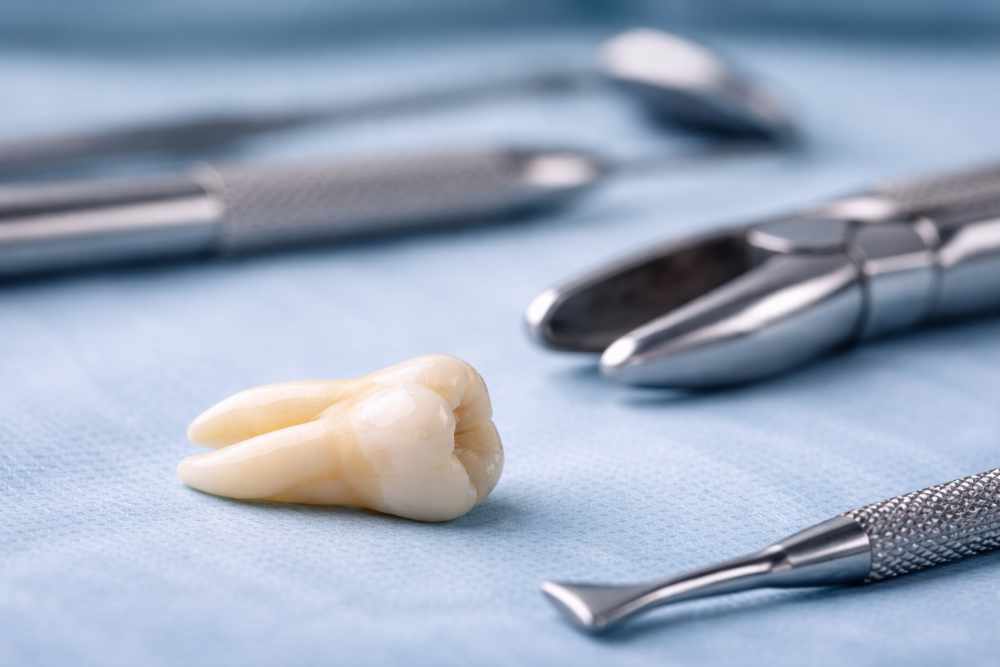
The wisdom teeth are the last teeth to erupt into the oral cavity. Usually this happens between the ages of 17 and 25, but in some cases they may appear later or not break through completely at all.
Due to the limited space at the back of the jaw, the wisdom teeth often remain partially blocked or completely retained in the bone. In such cases, they can cause various problems and this necessitates their surgical removal.
The decision to remove a wisdom tooth is made after clinical examination and imaging, and in some cases after a follow-up period.
👉 Detailed on topic: How does the consultation with a maxillofacial surgeon proceeds
When a wisdom tooth removal is needed
The removal of a wisdom tooth may be necessary in the following cases:
- Retained (blocked in the bone) tooth Retained (blocked in the bone) tooth -when the tooth cannot erupt (break through) in the mouth completely and remains partially or completely in the bone, this position creates objective (visible) or subjective (perceived by the patient) problems;
- Recurrent inflammation around the wisdom tooth;;
- Pain and swelling in the region of the back of the jaw;
- Damage to adjacent teeth, due to the traumatic position of the wisdom tooth;
- Formation of cysts or other entities around the retained tooth;
- Bite problems or the need for extraction within an orthodontic treatment plan.
In some cases, wisdom teeth may remain asymptomatic and do not require removal. The decision is made individually for each patient by the relevant dentist or surgeon.
What symptoms may occur
Wisdom teeth problems often manifest with symptoms such as:
- pain in the back of the jaw
- swelling of the gums or face
- difficulty opening the mouth
- unpleasant taste or smell in the mouth
- pain when chewing
👉 Detailed on topic: Pain in the jaw -possible causes
How the removal of a wisdom tooth is carried out
Wisdom tooth removal can be done through a standard tooth extraction or through a surgical procedure when the tooth is retained in the bone or positioned incorrectly.
The procedure is usually performed under local anesthesia, but in certain cases it could be performed under sedation or general anesthesia and includes:
- preparation of the operational field
- release of the tooth from the surrounding tissues, incl. with specialized devices
- tooth removal
- wound treatment
The length of the procedure depends on the position of the tooth and the complexity of the case.
Recovery after surgery
After the surgical removal of a retained wisdom tooth, it is possible to observe:
- soft tissue swelling
- pain or discomfort
- restricted mouth opening
- difficulty eating in the first days
The recovery period usually lasts from a few days to about a week.
👉 Detailed on topic: Recovery after wisdom tooth surgery and wound care
When is a surgical consultation recommended
Consultation with an oral or maxillofacial surgeon is advisable in cases of:
- pain in a dental area or a wisdom tooth / teeth that is not responsive to standard dental treatment approaches
- recurrent inflammation of the gums around the tooth
- swelling of the face or gums
- difficulty opening the mouth
👉 Detailed on topic: When should we visit a maxillofacial surgeon
Author:
Bulgarian Association of Oral and Maxillofacial Surgery